An advertiser calls and says they did not hear their commercial. What can you actually tell them?
Most stations reach for the log — the thing that says what was *supposed* to run. That is not evidence. It is a plan, and the whole question is whether the plan happened.
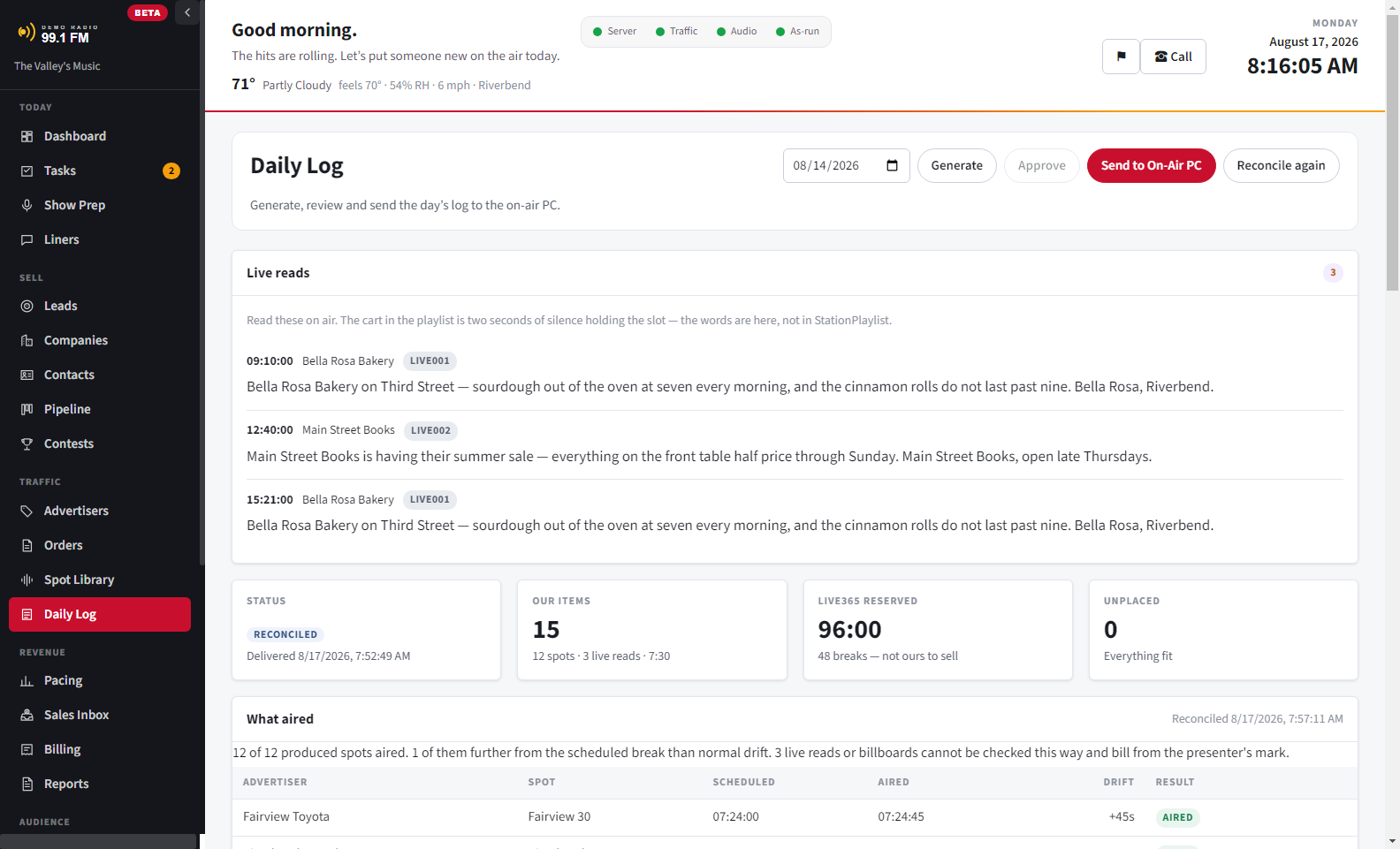
The only document that answers it is the as-run: the automation's own record of what it played, written after the fact. Reconciliation is the act of laying one against the other.
What reconciliation is actually doing
For every spot you sold on a given day, it asks a single question: does a matching entry exist in the as-run?
The answer is one of three things, and the third is the one that matters.
- Aired. Found in the as-run. You can tell the advertiser when, to the second, and prove it.
- Missed. Scheduled, delivered, and not in the as-run. This is a spot the advertiser paid for and did not get — a debt, not a discrepancy.
- Not proved. The day was never reconciled, so nobody knows. This is not a third outcome so much as an admission.
"Not proved" deserves its own state rather than being quietly counted as aired. A station that bills for a day it never checked is billing on an assumption.
Two ways this goes wrong quietly
Both of these produce a confident wrong answer, which is worse than no answer.
A partial as-run read as a complete one. If the import only got half the day — the file was still being written, or it was truncated — then every spot in the unread half looks missed. The station opens makegoods for spots that aired perfectly well, and credits an advertiser who got exactly what they bought.
The guard is to treat coverage as a fact about the file rather than an inference. A day whose as-run holds no commercial entries at all did not have a quiet day; it had a failed import, and those two must not look the same.
A skipped track counted as played. Automation logs often record *every* item they considered, including ones they skipped. If the importer reads a skip as a play, a spot that never made it to air is filed as proof that it did. That is the most expensive possible error, because it closes the question in the station's favor and nobody ever revisits it.
The fix is unglamorous: read the status column, and know what each of its values actually means in the system that wrote it.
Why the timing matters more than the accuracy
Reconciling is worth doing daily, and the reason is not tidiness.
A missed spot found the morning after, inside a flight with three weeks left, is a row in next Tuesday's log. Nobody has to phone anybody. The same missed spot found at invoice time cannot be made good at all — the campaign is over, and every remaining option costs money.
So the value of reconciliation is not the report. It is the *runway* it leaves you.
What to actually do
1. Reconcile every day, the day after. Not weekly, and not at month end. 2. Check the import covered the whole day before believing anything it says about what was missed. 3. Treat a miss as an obligation, with a decision attached — run it again, credit it, or agree to let it go — rather than as a line in a report. 4. Bill from what aired, not from what was scheduled. Those are different numbers, and only one of them is true.
Cartwright does all four, and puts the oldest day still owing a reconciliation on the Dashboard so the backlog cannot quietly grow.
---
*More on what happens once a miss is found: Spots you owe back. Or download Cartwright and try it free for 30 days.*